Saga Pattern em Go
William Prussak Macarini
17/02/2026BackendGOSaga Pattern
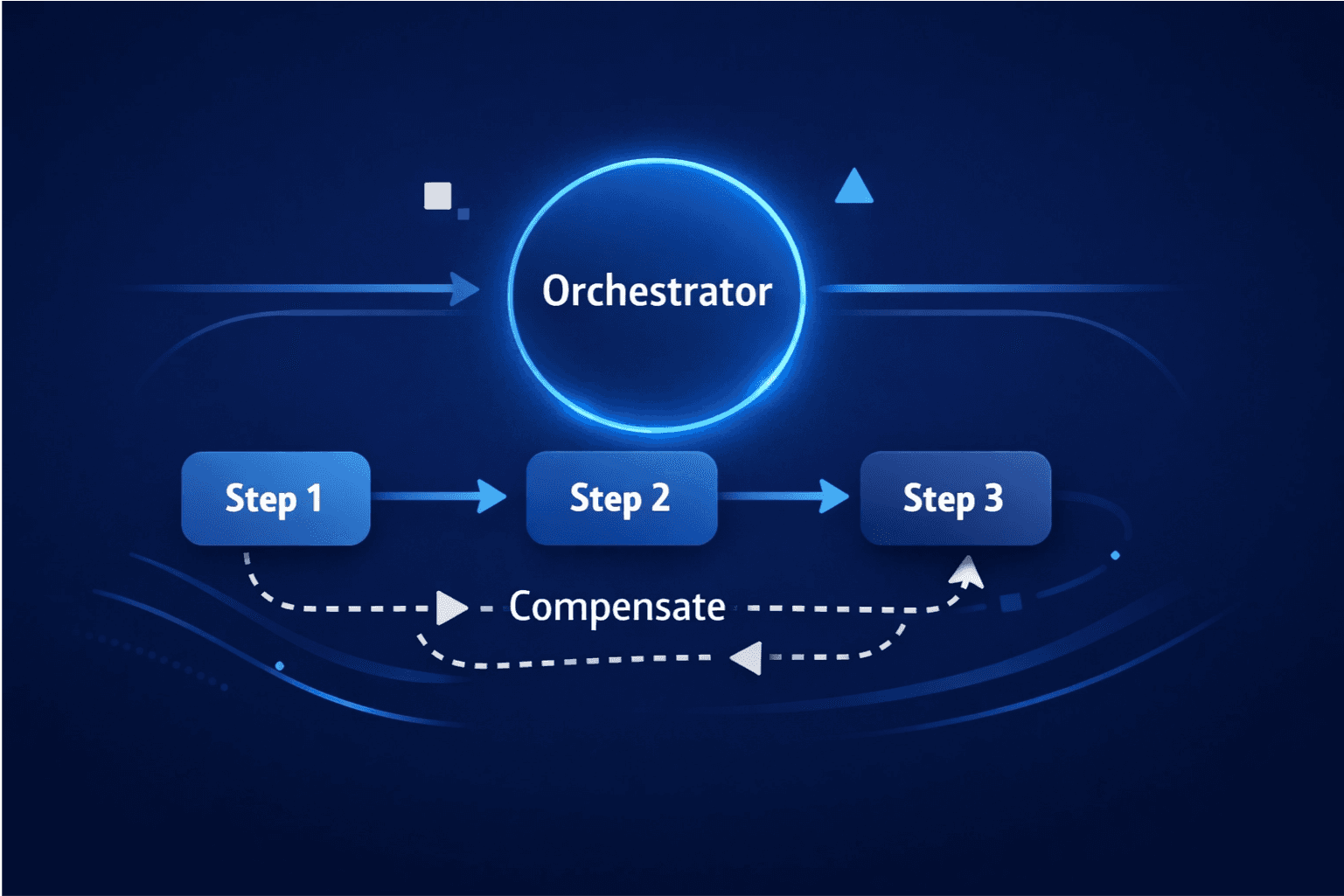
Em microservices, um “checkout” costuma envolver vários serviços (ex.: estoque, pagamento, entrega). O problema: você não consegue (ou não deve) abrir uma transação ACID única envolvendo múltiplos bancos/serviços. O Saga Pattern resolve isso usando consistência eventual:
Um step é uma operação que:
Por isso, normalmente modelamos cada step com dois métodos:
Do() → ação principalCompensate() → desfaz a ação principal (best effort)Compensação não é rollback transacional:
Existe um orquestrador (um serviço ou módulo) que:
Prós:
Contras:
Cada serviço publica eventos e outros reagem. Prós: mais desacoplado. Contras: mais difícil de rastrear/depurar no início.
Idempotência
Do() e Compensate() devem poder rodar mais de uma vez sem quebrar.Persistir progresso (state)
Retries + backoff
Compensate(), pois falhar em compensar é crítico.Timeouts e cancelamento com context.Context
Observabilidade
Fluxo:
Se falhar no step 3:
Abaixo, um exemplo didático (simulado em memória), mas com comentários bem detalhados.
package main

import (
	"context"
	"errors"
	"fmt"
	"log"
	"time"
)

// Step é a unidade do Saga.
// - Do: executa a ação principal.
// - Compensate: desfaz a ação principal (best effort).
type Step interface {
	Name() string
	Do(ctx context.Context) error
	Compensate(ctx context.Context) error
}

// Saga executa steps em ordem. Se falhar, compensa em ordem reversa.
type Saga struct {
	steps []Step
}

// Add registra steps na ordem em que devem rodar.
func (s *Saga) Add(steps ...Step) {
	s.steps = append(s.steps, steps...)
}

// Execute executa o fluxo principal.
// Em caso de falha, chama compensate() com os steps que já foram executados.
func (s *Saga) Execute(ctx context.Context) error {
	var executed []Step // guarda os steps que concluíram com sucesso

	for _, step := range s.steps {
		log.Printf("[saga] running step: %s", step.Name())

		if err := step.Do(ctx); err != nil {
			log.Printf("[saga] step failed: %s: %v", step.Name(), err)

			// Compensa apenas o que já foi executado.
			s.compensate(ctx, executed)

			return fmt.Errorf("saga failed at step %s: %w", step.Name(), err)
		}

		// Só entra aqui se o step concluiu bem.
		executed = append(executed, step)
	}

	log.Println("[saga] completed successfully")
	return nil
}

// compensate desfaz em ordem reversa.
// Observação: compensação pode falhar; em produção você guardaria e retentaria depois.
func (s *Saga) compensate(ctx context.Context, executed []Step) {
	log.Println("[saga] starting compensation...")

	for i := len(executed) - 1; i >= 0; i-- {
		step := executed[i]
		log.Printf("[saga] compensating: %s", step.Name())

		if err := step.Compensate(ctx); err != nil {
			// Em produção: persistir falha da compensação + reprocessar.
			log.Printf("[saga] compensation failed: %s: %v", step.Name(), err)
		}
	}

	log.Println("[saga] compensation finished")
}

// ----------------- Steps concretos (simulados) -----------------

// ReserveStockStep simula reservar estoque.
type ReserveStockStep struct {
	stock    map[string]int
	product  string
	qty      int
	reserved bool // serve para sabermos se precisamos compensar
}

func (s *ReserveStockStep) Name() string { return "reserve-stock" }

func (s *ReserveStockStep) Do(ctx context.Context) error {
	// Simula latência de rede/DB
	select {
	case <-ctx.Done():
		return ctx.Err()
	case <-time.After(120 * time.Millisecond):
	}

	available := s.stock[s.product]
	if available < s.qty {
		return fmt.Errorf("insufficient stock: have=%d want=%d", available, s.qty)
	}

	s.stock[s.product] -= s.qty
	s.reserved = true
	log.Printf("[stock] reserved %d of %s (remaining=%d)", s.qty, s.product, s.stock[s.product])
	return nil
}

func (s *ReserveStockStep) Compensate(ctx context.Context) error {
	// Idempotência básica: se não reservou, não compensa.
	if !s.reserved {
		return nil
	}

	select {
	case <-ctx.Done():
		return ctx.Err()
	case <-time.After(80 * time.Millisecond):
	}

	s.stock[s.product] += s.qty
	s.reserved = false
	log.Printf("[stock] released %d of %s (compensation)", s.qty, s.product)
	return nil
}

// ChargePaymentStep simula cobrar pagamento.
type ChargePaymentStep struct {
	charged bool
	amount  float64
}

func (p *ChargePaymentStep) Name() string { return "charge-payment" }

func (p *ChargePaymentStep) Do(ctx context.Context) error {
	select {
	case <-ctx.Done():
		return ctx.Err()
	case <-time.After(180 * time.Millisecond):
	}

	// Aqui poderia falhar por cartão recusado, gateway fora, etc.
	p.charged = true
	log.Printf("[payment] charged amount=%.2f", p.amount)
	return nil
}

func (p *ChargePaymentStep) Compensate(ctx context.Context) error {
	if !p.charged {
		return nil
	}

	select {
	case <-ctx.Done():
		return ctx.Err()
	case <-time.After(110 * time.Millisecond):
	}

	p.charged = false
	log.Printf("[payment] refunded amount=%.2f (compensation)", p.amount)
	return nil
}

// CreateShippingStep simula criar uma entrega.
type CreateShippingStep struct {
	created bool
	fail    bool
}

func (s *CreateShippingStep) Name() string { return "create-shipping" }

func (s *CreateShippingStep) Do(ctx context.Context) error {
	select {
	case <-ctx.Done():
		return ctx.Err()
	case <-time.After(140 * time.Millisecond):
	}

	if s.fail {
		// Simula o caso típico: provedor indisponível
		return errors.New("shipping provider unavailable")
	}

	s.created = true
	log.Printf("[shipping] created")
	return nil
}

func (s *CreateShippingStep) Compensate(ctx context.Context) error {
	// Nem sempre existe compensação; depende do domínio.
	// Aqui supomos que se criou, dá para cancelar.
	if !s.created {
		return nil
	}

	select {
	case <-ctx.Done():
		return ctx.Err()
	case <-time.After(90 * time.Millisecond):
	}

	s.created = false
	log.Printf("[shipping] canceled (compensation)")
	return nil
}

func main() {
	ctx, cancel := context.WithTimeout(context.Background(), 2*time.Second)
	defer cancel()

	// Estoque simulado
	stock := map[string]int{
		"notebook": 3,
	}

	// Monta o Saga (orquestração)
	saga := &Saga{}

	// Criamos os steps com os dados que precisam.
	reserve := &ReserveStockStep{stock: stock, product: "notebook", qty: 2}
	payment := &ChargePaymentStep{amount: 1999.90}
	shipping := &CreateShippingStep{fail: true} // forçando falha para ver compensação

	saga.Add(reserve, payment, shipping)

	if err := saga.Execute(ctx); err != nil {
		log.Println("RESULT:", err)
		return
	}

	log.Println("RESULT: checkout completed")
}
Se CreateShippingStep.Do() falha:
compensate().compensate() percorre os steps executados em ordem reversa:
ChargePaymentStep.Compensate() → estornaReserveStockStep.Compensate() → libera estoqueIsso é o “coração” do Saga.
Se quiser evoluir esse exemplo para produção, as próximas peças são:
sagas com saga_id, current_step, status, attempts)Do/CompensateSaga é um padrão essencial para orquestrar fluxos distribuídos com consistência eventual. Em Go, ele fica natural com interfaces simples (Do/Compensate) e um orquestrador que controla ordem, falhas e compensações.
Se você me disser seu cenário (ex.: checkout, criação de conta, provisionamento), eu adapto o exemplo para algo mais “real” com:
sagaIDIn microservices, a “checkout” typically spans multiple services (e.g., inventory, payment, shipping). The problem: you can’t realistically run a single ACID transaction across multiple databases/services. The Saga Pattern addresses this using eventual consistency:
A step is an operation that:
That’s why each step is usually modeled with two methods:
Do() → main actionCompensate() → undo the main action (best effort)Compensation is not a transactional rollback:
There is an orchestrator (a service/module) that:
Pros:
Cons:
Services react to events from others without a central coordinator. Pros: more decoupled. Cons: harder to trace end-to-end flows at the beginning.
Idempotency
Do() and Compensate() must be safe to execute multiple times.Persist progress (state)
Retries + backoff
Timeouts and cancellation via context.Context
Observability
Flow:
If step 3 fails:
Below is a didactic in-memory simulation with detailed comments.
package main

import (
	"context"
	"errors"
	"fmt"
	"log"
	"time"
)

// Step is the unit of a Saga.
// - Do: executes the main action.
// - Compensate: undoes the main action (best effort).
type Step interface {
	Name() string
	Do(ctx context.Context) error
	Compensate(ctx context.Context) error
}

// Saga runs steps in order. If a step fails, it compensates in reverse order.
type Saga struct {
	steps []Step
}

// Add registers steps in the execution order.
func (s *Saga) Add(steps ...Step) {
	s.steps = append(s.steps, steps...)
}

// Execute runs the main flow.
// If a step fails, compensate() is called with the already executed steps.
func (s *Saga) Execute(ctx context.Context) error {
	var executed []Step // steps that completed successfully

	for _, step := range s.steps {
		log.Printf("[saga] running step: %s", step.Name())

		if err := step.Do(ctx); err != nil {
			log.Printf("[saga] step failed: %s: %v", step.Name(), err)

			// Compensate only what already succeeded.
			s.compensate(ctx, executed)

			return fmt.Errorf("saga failed at step %s: %w", step.Name(), err)
		}

		executed = append(executed, step)
	}

	log.Println("[saga] completed successfully")
	return nil
}

// compensate undoes steps in reverse order.
// Note: compensations can fail; in production you’d persist failures and retry.
func (s *Saga) compensate(ctx context.Context, executed []Step) {
	log.Println("[saga] starting compensation...")

	for i := len(executed) - 1; i >= 0; i-- {
		step := executed[i]
		log.Printf("[saga] compensating: %s", step.Name())

		if err := step.Compensate(ctx); err != nil {
			// In production: persist this and reprocess later.
			log.Printf("[saga] compensation failed: %s: %v", step.Name(), err)
		}
	}

	log.Println("[saga] compensation finished")
}

// ----------------- Concrete steps (simulated) -----------------

// ReserveStockStep reserves stock.
type ReserveStockStep struct {
	stock    map[string]int
	product  string
	qty      int
	reserved bool // used to decide whether to compensate
}

func (s *ReserveStockStep) Name() string { return "reserve-stock" }

func (s *ReserveStockStep) Do(ctx context.Context) error {
	// Simulate network/DB latency
	select {
	case <-ctx.Done():
		return ctx.Err()
	case <-time.After(120 * time.Millisecond):
	}

	available := s.stock[s.product]
	if available < s.qty {
		return fmt.Errorf("insufficient stock: have=%d want=%d", available, s.qty)
	}

	s.stock[s.product] -= s.qty
	s.reserved = true
	log.Printf("[stock] reserved %d of %s (remaining=%d)", s.qty, s.product, s.stock[s.product])
	return nil
}

func (s *ReserveStockStep) Compensate(ctx context.Context) error {
	// Basic idempotency: if nothing was reserved, nothing to undo.
	if !s.reserved {
		return nil
	}

	select {
	case <-ctx.Done():
		return ctx.Err()
	case <-time.After(80 * time.Millisecond):
	}

	s.stock[s.product] += s.qty
	s.reserved = false
	log.Printf("[stock] released %d of %s (compensation)", s.qty, s.product)
	return nil
}

// ChargePaymentStep charges a payment.
type ChargePaymentStep struct {
	charged bool
	amount  float64
}

func (p *ChargePaymentStep) Name() string { return "charge-payment" }

func (p *ChargePaymentStep) Do(ctx context.Context) error {
	select {
	case <-ctx.Done():
		return ctx.Err()
	case <-time.After(180 * time.Millisecond):
	}

	// Could fail due to declined card, gateway outage, etc.
	p.charged = true
	log.Printf("[payment] charged amount=%.2f", p.amount)
	return nil
}

func (p *ChargePaymentStep) Compensate(ctx context.Context) error {
	if !p.charged {
		return nil
	}

	select {
	case <-ctx.Done():
		return ctx.Err()
	case <-time.After(110 * time.Millisecond):
	}

	p.charged = false
	log.Printf("[payment] refunded amount=%.2f (compensation)", p.amount)
	return nil
}

// CreateShippingStep creates a shipping order.
type CreateShippingStep struct {
	created bool
	fail    bool
}

func (s *CreateShippingStep) Name() string { return "create-shipping" }

func (s *CreateShippingStep) Do(ctx context.Context) error {
	select {
	case <-ctx.Done():
		return ctx.Err()
	case <-time.After(140 * time.Millisecond):
	}

	if s.fail {
		// Typical failure: provider unavailable
		return errors.New("shipping provider unavailable")
	}

	s.created = true
	log.Printf("[shipping] created")
	return nil
}

func (s *CreateShippingStep) Compensate(ctx context.Context) error {
	// Not every domain needs a compensation here.
	// In this example, if it was created, we can cancel it.
	if !s.created {
		return nil
	}

	select {
	case <-ctx.Done():
		return ctx.Err()
	case <-time.After(90 * time.Millisecond):
	}

	s.created = false
	log.Printf("[shipping] canceled (compensation)")
	return nil
}

func main() {
	ctx, cancel := context.WithTimeout(context.Background(), 2*time.Second)
	defer cancel()

	// Simulated stock
	stock := map[string]int{
		"laptop": 3,
	}

	// Build the Saga (orchestration)
	saga := &Saga{}

	reserve := &ReserveStockStep{stock: stock, product: "laptop", qty: 2}
	payment := &ChargePaymentStep{amount: 1999.90}
	shipping := &CreateShippingStep{fail: true} // force failure to demonstrate compensation

	saga.Add(reserve, payment, shipping)

	if err := saga.Execute(ctx); err != nil {
		log.Println("RESULT:", err)
		return
	}

	log.Println("RESULT: checkout completed")
}
If CreateShippingStep.Do() fails:
compensate().compensate() runs the executed steps in reverse order:
ChargePaymentStep.Compensate() → refundReserveStockStep.Compensate() → release stockThat’s the core of a Saga.
To move closer to real-world usage, you typically add:
sagas table with saga_id, current_step, status, attempts)Do/CompensateThe Saga Pattern is essential for orchestrating distributed workflows with eventual consistency. In Go, it maps cleanly to small interfaces (Do/Compensate) and an orchestrator that handles ordering, failures, and compensations.
If you share your concrete flow (checkout, account creation, provisioning, etc.), I can adapt the example to a more “real” setup with sagaID, persisted state, retries/backoff, and structured logs per step.